









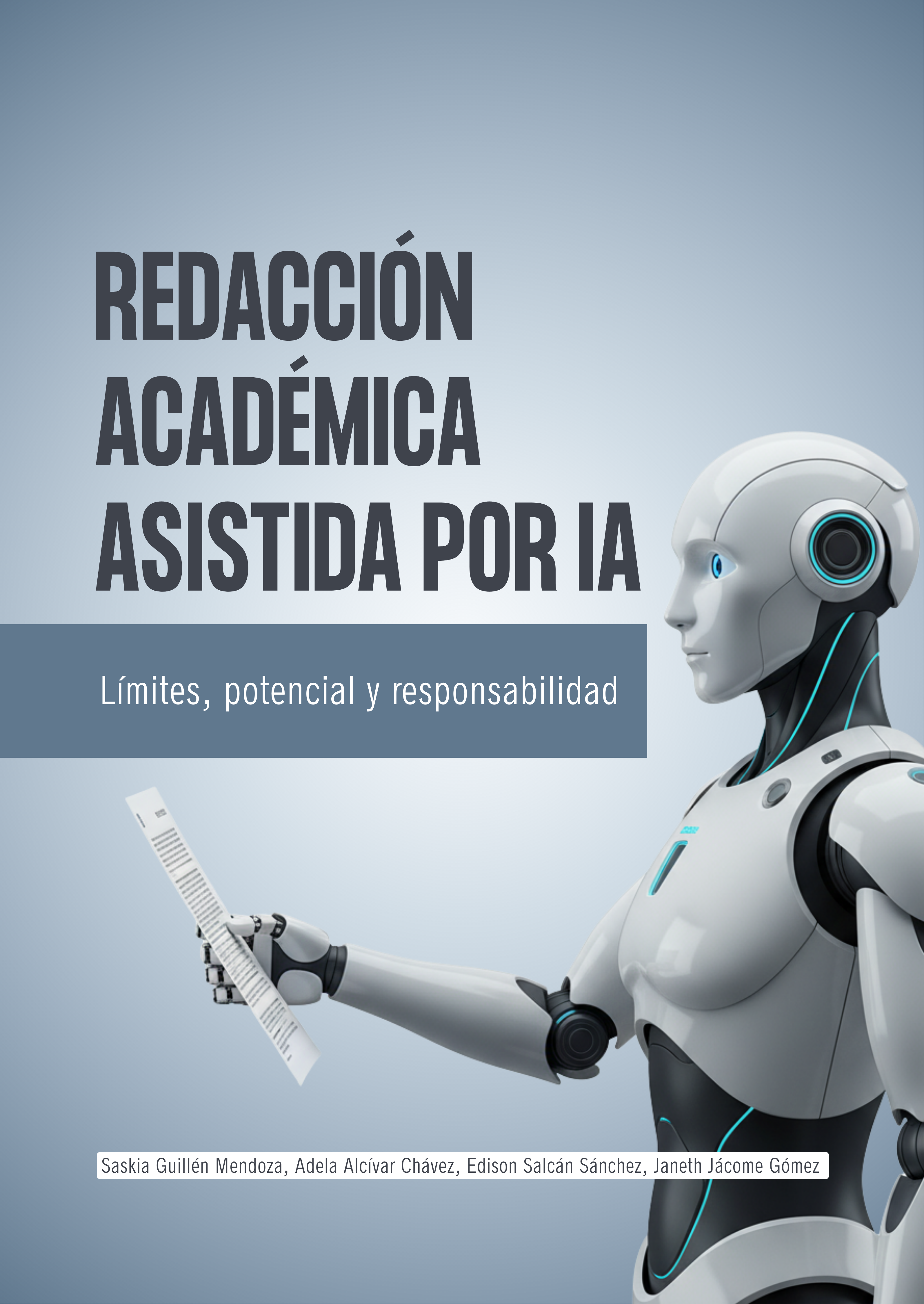
Este libro examina el impacto de la inteligencia artificial generativa en la escritura académica, con especial atención a sus implicancias cognitivas, discursivas, técnicas y éticas. A partir de una revisión crítica de literatura especializada, la obra analiza el rol de la inteligencia artificial como herramienta de asistencia en la producción de textos científicos. El foco se sitúa en comprender cómo estos sistemas procesan información, generan texto y condicionan las prácticas de autoría, así como en identificar sus limitaciones técnicas y los riesgos asociados a su uso acrítico. El libro desarrolla una arquitectura conceptual que permite diferenciar entre asistentes generales y herramientas especializadas, abordando problemáticas como el plagio y el autoplagio asistido por inteligencia artificial, la transparencia en el uso de estas tecnologías y la responsabilidad compartida entre autores, revisores y editores. Asimismo, se discuten cuestiones vinculadas al mérito académico, la creatividad y la evaluación del trabajo intelectual en contextos mediados por sistemas automatizados. Desde una perspectiva aplicada, la obra explora usos concretos de la inteligencia artificial en la redacción académica, incluyendo la reformulación y mejora del estilo, la detección de errores lingüísticos, la generación de borradores, resúmenes y esquemas, la traducción y la automatización de tareas repetitivas. Finalmente, se proponen orientaciones prácticas para integrar estas herramientas de manera responsable en las distintas secciones del manuscrito científico, mediante el uso reflexivo de prompts y recursos especializados, promoviendo prácticas de escritura coherentes con los principios de integridad académica y rigor intelectual.
Aharoni, R., & Goldberg, Y. (2020). Unsupervised domain clusters in pretrained language models. arXiv preprint arXiv:2004.02105. https://doi.org/10.48550/arXiv.2004.02105
Bai, L., Liu, X., & Su, J. (2023). ChatGPT: The cognitive effects on learning and memory. Brain‐X, 1(3), e30. https://doi.org/10.1002/brx2.30
Barreto, F., Moharkar, L., Shirodkar, M., Sarode, V., Gonsalves, S., & Johns, A. (2023, February). Generative artificial intelligence: Opportunities and challenges of large language models. In International conference on intelligent computing and networking (pp. 545-553). Singapore: Springer Nature Singapore. https://doi.org/10.1007/978-981-99-3177-4_41
Bauer, N. F. (2025). Does ChatGPT Increase Language Homogenization?. In KI in Medien, Kommunikation und Marketing: Wirtschaftliche, gesellschaftliche und rechtliche Perspektiven (pp. 11-31). Wiesbaden: Springer Fachmedien Wiesbaden. https://doi.org/10.1007/978-3-658-46344-1_2
Biagioli, M., & Galison, P. (2014). Scientific authorship: Credit and intellectual property in science. Routledge.
Bracewell, R. J. (1980). Writing as a cognitive activity. Visible language, 14(4).
Butlin, P., & Lappas, T. (2025). Principles for responsible AI consciousness research. Journal of Artificial Intelligence Research, 82, 1673-1690. https://doi.org/10.1613/jair.1.17310
Cañas, J. J. (2022). AI and ethics when human beings collaborate with AI agents. Frontiers in psychology, 13, 836650. https://doi.org/10.3389/fpsyg.2022.836650
Cardon, P., Fleischmann, C., Aritz, J., Logemann, M., & Heidewald, J. (2023). The challenges and opportunities of AI-assisted writing: Developing AI literacy for the AI age. Business and Professional Communication Quarterly, 86(3), 257-295. https://doi.org/10.1177/23294906231176517
Carobene, A., Padoan, A., Cabitza, F., Banfi, G., & Plebani, M. (2024). Rising adoption of artificial intelligence in scientific publishing: evaluating the role, risks, and ethical implications in paper drafting and review process. Clinical Chemistry and Laboratory Medicine (CCLM), 62(5), 835-843. https://doi.org/10.1515/cclm-2023-1136
Contreras Kallens, P., Kristensen‐McLachlan, R. D., & Christiansen, M. H. (2023). Large language models demonstrate the potential of statistical learning in language. Cognitive Science, 47(3), e13256. https://doi.org/10.1111/cogs.13256
Curzer, H. J. (2021). Authorship and justice: credit and responsibility. Accountability in Research, 28(1), 1-22. https://doi.org/10.1080/08989621.2020.1794855
Duin, A. H., & Pedersen, I. (2021). Algorithmic writing futures. In Writing futures: Collaborative, algorithmic, autonomous (pp. 53-84). Cham: Springer International Publishing. https://doi.org/10.1007/978-3-030-70928-0_3
Durt, C., & Fuchs, T. (2024). Large language models and the patterns of human language use. In Phenomenologies of the Digital Age (pp. 106-121). Routledge.
Emsley, R. (2023). ChatGPT: these are not hallucinations–they’re fabrications and falsifications. Schizophrenia, 9(1), 52. https://doi.org/10.1038/s41537-023-00379-4
Fauziah, R. R., Puspita, A. M. I., Yuliana, I., Ummah, F. S., Mufarochah, S., & Ramadhani, E. (2025). Artificial intelligence in academic writing: Enhancing or replacing human expertise?. Journal of Clinical Neuroscience, 111193. https://doi.org/10.1016/j.jocn.2025.111193
Ge, J., Luo, H., Qian, S., Gan, Y., Fu, J., & Zhang, S. (2023). Chain of thought prompt tuning in vision language models. arXiv preprint arXiv:2304.07919. https://doi.org/10.48550/arXiv.2304.07919
Geroimenko, V. (2025). Key Techniques for Writing Effective Prompts. In The Essential Guide to Prompt Engineering: Key Principles, Techniques, Challenges, and Security Risks (pp. 37-83). Cham: Springer Nature Switzerland. https://doi.org/10.1007/978-3-031-86206-9_3
Gkintoni, E., Antonopoulou, H., Sortwell, A., & Halkiopoulos, C. (2025). Challenging cognitive load theory: The role of educational neuroscience and artificial intelligence in redefining learning efficacy. Brain Sciences, 15(2), 203. https://doi.org/10.3390/brainsci15020203
Gloeckle, F., Idrissi, B. Y., Rozière, B., Lopez-Paz, D., & Synnaeve, G. (2024). Better & faster large language models via multi-token prediction. arXiv preprint arXiv:2404.19737. https://doi.org/10.48550/arXiv.2404.19737
Gravel, J., D’Amours-Gravel, M., & Osmanlliu, E. (2023). Learning to fake it: limited responses and fabricated references provided by ChatGPT for medical questions. Mayo Clinic Proceedings: Digital Health, 1(3), 226-234. https://doi.org/10.1016/j.mcpdig.2023.05.004
Guo, H., & Zaini, S. H. (2024). Artificial intelligence in academic writing: A literature review. Asian Pendidikan, 4(2), 46-55. https://doi.org/10.53797/aspen.v4i2.6.2024
Hall, P., & Ellis, D. (2023). A systematic review of socio-technical gender bias in AI algorithms. Online Information Review, 47(7), 1264-1279. https://doi.org/10.1108/OIR-08-2021-0452
Halupa, C. (2023). ALGIARISM: Artificial intelligence-assisted plagiarism. In EDULEARN23 proceedings (pp. 1018-1024). IATED. https://doi.org/10.21125/edulearn.2023.0363
He, J., Rungta, M., Koleczek, D., Sekhon, A., Wang, F. X., & Hasan, S. (2024). Does prompt formatting have any impact on llm performance?. arXiv preprint arXiv:2411.10541. https://doi.org/10.48550/arXiv.2411.10541
Heilmann, T. A. (2023). The beginnings of word processing: A historical account. In Digital Writing Technologies in Higher Education: Theory, Research, and Practice (pp. 3-14). Cham: Springer International Publishing. https://doi.org/10.1007/978-3-031-36033-6_1
Hyland, K. (2014). Disciplinary discourses: Writer stance in research articles. In Writing: Texts, processes and practices (pp. 99-121). Routledge.
Ilievski, F., Hammer, B., van Harmelen, F., Paassen, B., Saralajew, S., Schmid, U., ... & Villmann, T. (2025). Aligning generalization between humans and machines. Nature Machine Intelligence, 1-12. https://doi.org/10.1038/s42256-025-01109-4
Jiang, F. K., & Hyland, K. (2025). Metadiscursive nouns in academic argument: ChatGPT vs student practices. Journal of English for Academic Purposes, 75, 101514. https://doi.org/10.1016/j.jeap.2025.101514
Joshi, M. (2025). Foundations of Reading, Writing, and Proving. Educohack Press.
Karn, A., Singh, P. K., Agarwal, C., Verma, A., Singh, D., & Kumari, M. (2024). Unraveling the power of AI assistants. In Advances in AI for biomedical instrumentation, electronics and computing (pp. 473-479). CRC Press.
Khalifa, M., & Albadawy, M. (2024). Using artificial intelligence in academic writing and research: An essential productivity tool. Computer Methods and Programs in Biomedicine Update, 5, 100145. https://doi.org/10.1016/j.cmpbup.2024.100145
Kim, Y., Belcher, D., & Peyton, C. (2023). Comparing monomodal traditional writing and digital multimodal composing in EAP classrooms: Linguistic performance and writing development. Journal of English for Academic Purposes, 64, 101247. https://doi.org/10.1016/j.jeap.2023.101247
Kovari, A. (2025, January). Ethical use of ChatGPT in education—Best practices to combat AI-induced plagiarism. In Frontiers in Education (Vol. 9, p. 1465703). Frontiers Media SA. https://doi.org/10.3389/feduc.2024.1465703
Largo, J. (2025). Beyond representation: rethinking intelligence in the age of LLMs. Synthese, 206(6), 280. https://doi.org/10.1007/s11229-025-05373-0
Lazaridou, A., Gribovskaya, E., Stokowiec, W., & Grigorev, N. (2022). Internet-augmented language models through few-shot prompting for open-domain question answering. arXiv preprint arXiv:2203.05115. https://doi.org/10.48550/arXiv.2203.05115
Leacock, C., Chodorow, M., Gamon, M., & Tetreault, J. (2022). History of Automated Grammatical Error Detection. In Automated Grammatical Error Detection for Language Learners (pp. 5-13). Cham: Springer International Publishing. https://doi.org/10.1007/978-3-031-02137-4_2
Levin, I., Marom, M., & Kojukhov, A. (2025). Rethinking AI in Education: Highlighting the Metacognitive Challenge. BRAIN. Broad Research in Artificial Intelligence and Neuroscience, 16(1 Sup1), 250-263. http://dx.doi.org/10.70594/brain/16.S1/21
Li, W. Y. (2017). Concepts of authorship. The Oxford Handbook of Classical Chinese Literature (1000 BCE–900 CE), Oxford, 360-76.
Liu, Y., & Fu, Z. (2024). Hybrid intelligence: design for sustainable multiverse via integrative cognitive creation model through human–computer collaboration. Applied Sciences, 14(11), 4662. https://doi.org/10.3390/app14114662
Liu, Y., Xu, J., Zhang, L. L., Chen, Q., Feng, X., Chen, Y., ... & Cheng, P. (2025). Beyond Prompt Content: Enhancing LLM Performance via Content-Format Integrated Prompt Optimization. arXiv preprint arXiv:2502.04295. https://doi.org/10.48550/arXiv.2502.04295
Long, S., Tan, J., Mao, B., Tang, F., Li, Y., Zhao, M., & Kato, N. (2025). A survey on intelligent network operations and performance optimization based on large language models. IEEE Communications Surveys & Tutorials. https://doi.org/10.1109/COMST.2025.3526606
Lund, B. D., & Naheem, K. T. (2024). Can ChatGPT be an author? A study of artificial intelligence authorship policies in top academic journals. Learned Publishing, 37(1), 13-21. https://doi.org/10.1002/leap.1582
Lyons, M. (2021). Typewriter century: A cultural history of writing practices (Vol. 46). University of Toronto Press.
Ma, R., Wang, X., Zhou, X., Li, J., Du, N., Gui, T., ... & Huang, X. (2024). Are large language models good prompt optimizers?. arXiv preprint arXiv:2402.02101. https://doi.org/10.48550/arXiv.2402.02101
Macagno, F. (2021). Argumentation schemes in AI: A literature review. Introduction to the special issue. Argument & Computation, 12(3), 287-302. https://doi.org/10.3233/AAC-210020
Maleki, N., Padmanabhan, B., & Dutta, K. (2024, June). AI hallucinations: a misnomer worth clarifying. In 2024 IEEE conference on artificial intelligence (CAI) (pp. 133-138). IEEE. https://doi.org/10.1109/CAI59869.2024.00033
Marquis, Y., Oladoyinbo, T. O., Olabanji, S. O., Olaniyi, O. O., & Ajayi, S. A. (2024). Proliferation of AI tools: A multifaceted evaluation of user perceptions and emerging trend. Asian Journal of Advanced Research and Reports, 18(1), 30-55.
Mazzi, F. (2024). Authorship in artificial intelligence‐generated works: Exploring originality in text prompts and artificial intelligence outputs through philosophical foundations of copyright and collage protection. The Journal of World Intellectual Property, 27(3), 410-427. https://doi.org/10.1111/jwip.12310
Meincke, L., Mollick, E. R., & Terwiesch, C. (2024). Prompting diverse ideas: Increasing AI idea variance. arXiv preprint arXiv:2402.01727. https://doi.org/10.48550/arXiv.2402.01727
Moffatt, B., & Hall, A. (2025). Is AI my co-author? The ethics of using artificial intelligence in scientific publishing. Accountability in research, 32(8), 1313-1329. https://doi.org/10.1080/08989621.2024.2386285
Mora-Cantallops, M., Sánchez-Alonso, S., García-Barriocanal, E., & Sicilia, M. A. (2021). Traceability for trustworthy AI: a review of models and tools. Big Data and Cognitive Computing, 5(2), 20. https://doi.org/10.3390/bdcc5020020
Mujica-Sequera, R. M. (2025). AI Prompts: Tools for Optimizing Scientific Research. Revista Tecnológica-Educativa Docentes 2.0, 18(1), 267-277. https://doi.org/10.37843/rted.v18i1.616
Nandi, S. K., Ratti, R., Singh, S. R., & Nandi, S. (2025). Prompt Engineering-Based Network Intrusion Detection System. IEEE Access, 13, 190859-190871. https://doi.org/10.1109/access.2025.3629761
Naseer, A., Ahmad, N. R., & Chishti, M. A. (2025). Psychological Impacts of AI Dependence: Assessing the Cognitive and Emotional Costs of Intelligent Systems in Daily Life. Review of Applied Management and Social Sciences, 8(1), 291-307. https://doi.org/10.47067/ramss.v8i1.458
Naveed, H., Khan, A. U., Qiu, S., Saqib, M., Anwar, S., Usman, M., ... & Mian, A. (2025). A comprehensive overview of large language models. ACM Transactions on Intelligent Systems and Technology, 16(5), 1-72. https://doi.org/10.1145/3744746
Nguyen, M., Gupta, S., & Le, H. (2025). Probabilities Are All You Need: A Probability-Only Approach to Uncertainty Estimation in Large Language Models. arXiv preprint arXiv:2511.07694. https://doi.org/10.48550/arXiv.2511.07694
Oppenlaender, J., Linder, R., & Silvennoinen, J. (2025). Prompting AI art: An investigation into the creative skill of prompt engineering. International journal of human–computer interaction, 41(16), 10207-10229. https://doi.org/10.1080/10447318.2024.2431761
Osadci-Baciu, A. M., & Zbuchea, A. (2024). The Economics of Publishing: A Bibliometric Research Landscape. The USV Annals of Economics and Public Administration, 24(1 (39)), 90-105.
Oshima, A., & Hogue, A. (2007). Introduction to academic writing. London: Pearson/Longman.
Otani, N., Ozaki, S., Zhao, X., Li, Y., St Johns, M., & Levin, L. (2020, November). Pre-tokenization of multi-word expressions in cross-lingual word embeddings. In Proceedings of the 2020 Conference on Empirical Methods in Natural Language Processing (EMNLP) (pp. 4451-4464). https://doi.org/10.18653/v1/2020.emnlp-main.360
Pierazzo, E. (2016). Digital scholarly editing: Theories, models and methods. Routledge. https://doi.org/10.4324/9781315577227
Prakash, A., Aggarwal, S., Varghese, J. J., & Varghese, J. J. (2025). Writing without borders: AI and cross-cultural convergence in academic writing quality. Humanities and Social Sciences Communications, 12(1), 1-11. https://doi.org/10.1057/s41599-025-05484-6
Rahimi, S., Dede, C., Esmaeiligoujar, S., & Babaee, M. (2026). Augmenting human creativity with responsible and ethical use of generative AI. In Generative Artificial Intelligence and Creativity (pp. 87-99). Academic Press. https://doi.org/10.1016/B978-0-443-34073-4.00010-1
Raiaan, M. A. K., Mukta, M. S. H., Fatema, K., Fahad, N. M., Sakib, S., Mim, M. M. J., ... & Azam, S. (2024). A review on large language models: Architectures, applications, taxonomies, open issues and challenges. IEEE access, 12, 26839-26874. https://doi.org/10.1109/ACCESS.2024.3365742
Robertson, A., & Maccarone, M. (2023). AI narratives and unequal conditions. Analyzing the discourse of liminal expert voices in discursive communicative spaces. Telecommunications Policy, 47(5), 102462. https://doi.org/10.1016/j.telpol.2022.102462
Salvagno, M., Taccone, F. S., & Gerli, A. G. (2023). Artificial intelligence hallucinations. Critical Care, 27(1), 180. https://doi.org/10.1186/s13054-023-04473-y
Sansanee, H., & Kiattisin, S. (2024, June). The current state of generative AI prompt framework design for enhancing utility in organizational decision-making. In 2024 5th Technology Innovation Management and Engineering Science International Conference (TIMES-iCON) (pp. 1-6). IEEE. https://doi.org/10.1109/TIMES-iCON61890.2024.10630713
Saxena, V., Tamo-Larrieux, A., Van Dijck, G., & Spanakis, G. (2025). Responsible guidelines for authorship attribution tasks in NLP. Ethics and Information Technology, 27(2), 1-28. https://doi.org/10.1007/s10676-025-09821-w
Shanahan, M., McDonell, K., & Reynolds, L. (2023). Role play with large language models. Nature, 623(7987), 493-498. https://doi.org/10.1038/s41586-023-06647-8
Shin, D. (2025). Automating epistemology: how AI reconfigures truth, authority, and verification. AI & SOCIETY, 1-7. https://doi.org/10.1007/s00146-025-02560-y
Simon, J. (2022). Scientific publishing: Agents, genres, technique and the making of knowledge. Histories, 2(4), 516-541. https://doi.org/10.3390/histories2040035
Srinivasan, K. P. V., Gumpena, P., Yattapu, M., & Brahmbhatt, V. H. (2024). Comparative analysis of different efficient fine tuning methods of large language models (llms) in low-resource setting. arXiv preprint arXiv:2405.13181. https://doi.org/10.48550/arXiv.2405.13181
Strobl, C., Ailhaud, E., Benetos, K., Devitt, A., Kruse, O., Proske, A., & Rapp, C. (2019). Digital support for academic writing: A review of technologies and pedagogies. Computers & education, 131, 33-48. https://doi.org/10.1016/j.compedu.2018.12.005
Swarts, J. (2017). Together with technology: writing review, enculturation, and technological mediation. Routledge.
Tambe, T. J. (2025). Association of Cognitive Load and Cognitive Fatigue in Artificial Intelligence Dependent Research Scholars. IJSAT-International Journal on Science and Technology, 16(4). https://doi.org/10.71097/IJSAT.v16.i4.9673
Tang, A., Li, K. K., Kwok, K. O., Cao, L., Luong, S., & Tam, W. (2024). The importance of transparency: Declaring the use of generative artificial intelligence (AI) in academic writing. Journal of nursing scholarship, 56(2), 314-318. https://doi.org/10.1111/jnu.12938
Tang, T., Li, J., Zhao, W. X., & Wen, J. R. (2022). Context-tuning: Learning contextualized prompts for natural language generation. arXiv preprint arXiv:2201.08670. https://doi.org/10.48550/arXiv.2201.08670
Tarkang, E. E., Kweku, M., & Zotor, F. B. (2017). Publication practices and responsible authorship: a review article. Journal of public health in Africa, 8(1), 723. https://doi.org/10.4081/jphia.2017.723
Tsao, J., & Nogues, C. (2024). Beyond the author: Artificial intelligence, creative writing and intellectual emancipation. Poetics, 102, 101865. https://doi.org/10.1016/j.poetic.2024.101865
Von Stecher, P. (2025). Las nuevas irregularidades del lenguaje. Desafíos de interpretación y mecanismos de simplificación discursiva de la inteligencia artificial. Forma y Función, 38(1). https://doi.org/10.15446/fyf.v38n1.114947
Vu, P., & Vu, L. (2025, November). Enhancing collaborative writing with AI-enhanced feedback in graduate-level action research courses. In Artificial Intelligence in Education (pp. 1-16). Emerald Publishing Limited. https://doi.org/10.1108/AIIE-03-2025-0042
Walton, P. (2018). Artificial intelligence and the limitations of information. Information, 9(12), 332. https://doi.org/10.3390/info9120332
Wiwanitmkit, S., & Wiwanitkit, V. (2024). Artificial Intelligence, Academic Publishing, Scientific Writing, Peer Review, and Ethics. Brazilian Journal of Cardiovascular Surgery, 39(4), e20230377. https://doi.org/10.21470/1678-9741-2023-0377
Xiao, Y. (2023). Decoding authorship: is there really no place for an algorithmic author under copyright law?. IIC-International Review of Intellectual Property and Competition Law, 54(1), 5-25. https://doi.org/10.1007/s40319-022-01269-5
Xu, Y., Polio, C., & Pfau, A. (2024). Optimizing AI for assessing L2 writing accuracy: An exploration of temperatures and prompts. Exploring artificial intelligence in applied linguistics, 151-174. https://doi.org/10.31274/isudp.2024.154.10
Zhang, M., Ye, X., Liu, Q., Ren, P., Wu, S., & Chen, Z. (2024). Uncovering overfitting in large language model editing. arXiv preprint arXiv:2410.07819. https://doi.org/10.48550/arXiv.2410.07819

Acceso abierto y distribuido según los términos y condiciones de la licencia Creative Commons Atribución-NoComercial-CompartirIgual 4.0 Internacional (CC BY-NC-SA 4.0).